
What Actually Matters Beyond the Gantt Chart
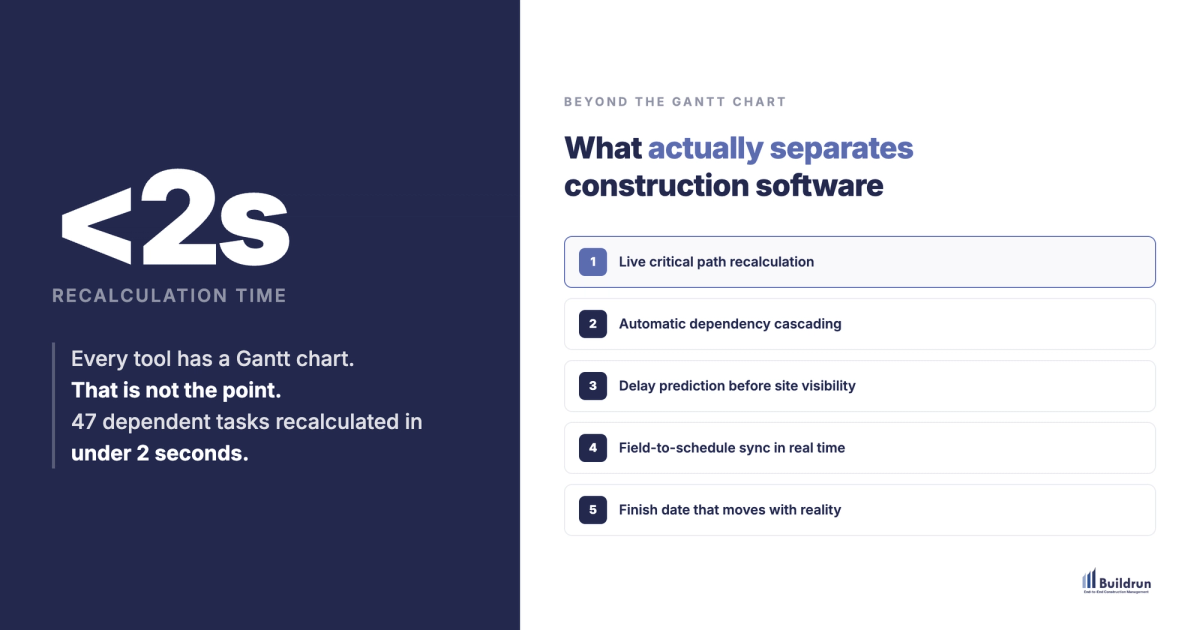
The feature checklist
Every construction management software in 2026 has a Gantt chart. A mobile app. A dashboard. A reporting module.
If you're evaluating tools and a vendor is pitching "we have scheduling + dashboards + mobile" - that's not a differentiator. That's a feature checklist every tool in the market already has.
The feature that actually separates tools isn't on any comparison sheet.
It's this: when a task slips on your site at 10 AM on Monday, does your schedule know by 10:01 AM? Or by Thursday?
The real cost of a 4-day lag
Here's a scenario that plays out on construction sites every week.
Monday 10 AM: A site engineer notices slab work on Tower B, Floor 7 hasn't started. The concrete subcontractor is short on labour.
By 10:30 AM: He tells the supervisor. Maybe sends a WhatsApp message.
Wednesday: The planner gets around to updating the schedule. But now he needs to manually adjust 47 dependent tasks - waterproofing, plaster, electrical, plumbing - everything downstream of that slab.
Thursday: He finishes the update. Sends a revised PDF to the PM.
Friday: The PM reviews it in the weekly meeting.
That's a 4-5 day gap between "the site knew" and "leadership could act." In that window, three other tasks have already started based on the old schedule. Rework becomes inevitable.
A project with 200 tasks has 40-50 dependency chains. One slip affects 15-30 downstream activities. If recalculating those dependencies takes a planner 4-5 hours, leadership is making decisions based on a schedule that describes a project that no longer exists.
What we built Buildrun to solve
This is the problem we started with.
Not "how do we build another Gantt chart." But "how do we make the schedule reflect reality in real time - so decisions happen the same morning, not the same Friday."
The answer was an intelligent Auto-Scheduler. When a site engineer marks a task as delayed from their phone at 10 AM, the system recalculates all 47 dependent tasks in under 2 seconds. The project finish date updates immediately. The dashboard shows the impact before the engineer has walked to the next section.
No planner needed to manually adjust timelines. No 4-day lag. No decisions made on stale data.
That single capability - schedule recalculation in seconds, not hours - changes how construction teams operate. Because when the schedule is always current, everything else follows: meetings get shorter, phone calls drop, and leadership sees problems before they compound.
What happened when teams started using it
We didn't build Buildrun based on assumptions and hope it worked. We built it on sites.
- Across 25M+ sq.ft. of construction projects we help manage, here's what the data shows:
- Site meetings went from 60 minutes to 5 minutes. When everyone walks into the room seeing the same live dashboard, the first 55 minutes of status updates become unnecessary. The meeting starts at the decision point.
- PMs went from 10 daily calls to 1-2. When progress, procurement, quality, and scheduling all update from one input at the source - the site - the PM opens a dashboard instead of making a phone call.
- QC inspection completion went from roughly 60% to over 98%. Not because engineers became more diligent - because digital checklists with mandatory fields and GPS-tagged photos made compliance faster than skipping.
- Staff efficiency increased by 40%. When you stop spending 8-10 hours per week updating Excel sheets and start spending 5 minutes, that time goes back to actually managing the project.
These aren't projections. These are measured results from real deployments, including the Jewel of India Phase 2 project - 264 luxury units, 1.57 million sq.ft., delivered on schedule.
Built for Indian construction sites
Most construction software is designed for a desk. Buildrun was designed for actual scenarios of an active site.
That means:
- Mobile-first. Site engineers update task status from their phones in under 30 seconds.
- GPS-validated photos. Every photo is tagged with location coordinates and timestamps. No more "which floor is this from?" debates.
- Works without perfect internet. Construction sites in India don't have reliable network. Offline capability with auto-sync isn't optional - it's a requirement.
- RERA-ready compliance. India-specific regulatory workflows built in, not bolted on.
Our team is based in Gurgaon. We visit sites in NCR. Not for demos - for onboarding. We train site engineers on the scaffolding, in the dust, on their phones, on their data connections. Because that's where the software needs to work.
500+ active site users across our deployments didn't happen because someone sent a training PDF. It happened because someone from our team stood next to them and said "try it while I'm here."
The question worth asking
The next time you evaluate construction management software - or question whether your current setup is working - skip the feature comparison.
Ask one question: how many seconds does it take to recalculate 47 dependent tasks when one of them slips?
If the answer isn't measured in seconds, the schedule is always behind the site. And if the schedule is always behind the site, every decision made from it is based on a project that no longer exists.
See how this works in practice
Buildrun gives construction teams live project data, automated scheduling, and real-time progress tracking - across every site, every day. See it working on a real project.