RERA Compliance in Construction: How Software Keeps Your Projects Audit-Ready
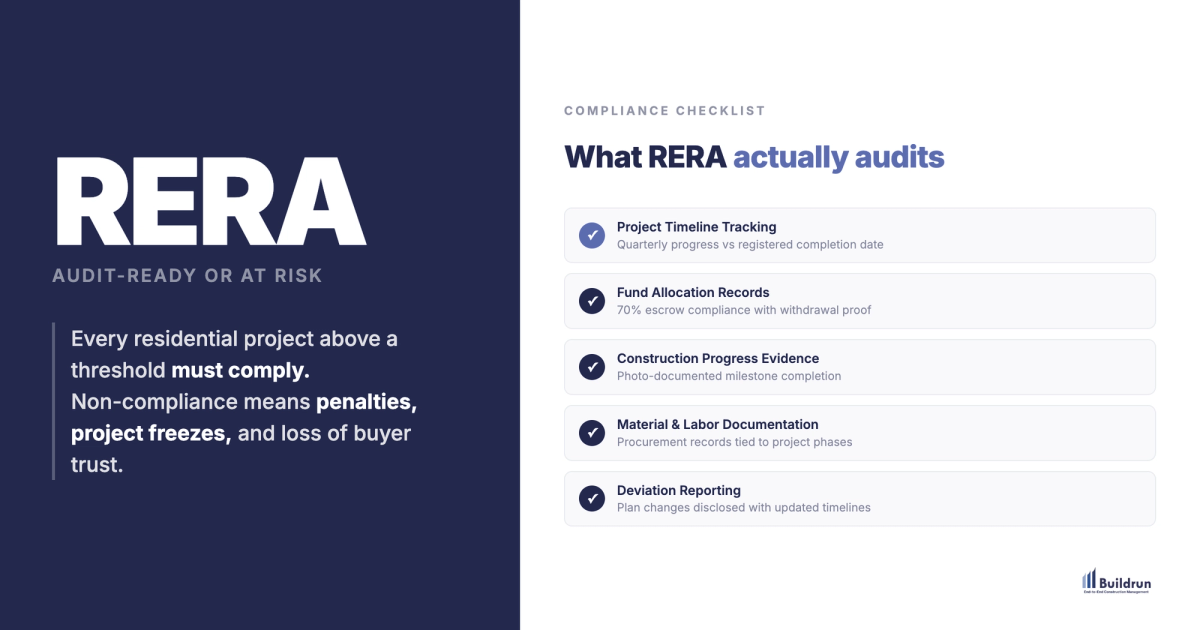
Real estate development in India operates under one of the most structured regulatory frameworks in the world. Since the Real Estate (Regulation and Development) Act was enacted in 2016 and came into full effect in 2017, every residential and commercial project above a certain threshold must meet specific documentation, reporting, and timeline standards - not as a bureaucratic formality, but as a condition of doing business.
For developers managing multiple projects across different phases, RERA compliance is an ongoing operational requirement that touches scheduling, fund management, progress reporting, and quality documentation - every quarter, for every registered project.
Most teams understand RERA well enough. The harder question is whether your systems can produce the evidence of compliance when it matters.
What RERA Actually Demands From Project Execution Teams
RERA compliance is often discussed in legal terms - registration, escrow accounts, advertising restrictions. But at the project execution level, four requirements drive the most operational complexity:
1. Quarterly Progress Updates
Every registered project must file quarterly updates with the state RERA authority. These updates include construction progress percentages, timelines achieved versus committed, and any deviations from the original project plan. The data must be accurate, current, and verifiable.
2. Fund Allocation Compliance
RERA mandates that 70% of funds collected from buyers must be deposited in a designated escrow account and used exclusively for that project's construction and land costs. Withdrawals require certification from an engineer, an architect, and a chartered accountant - all confirming that the spending corresponds to actual construction progress.
3. Timeline Commitments
The completion date declared at registration is binding. Extensions require formal applications with documented justification. Developers who consistently miss timelines face scrutiny from RERA authorities and from buyers who now have a structured grievance mechanism.
4. Accurate Advertising and Disclosure
Every claim made in marketing materials - including project timelines, amenity commitments, and specification details - must match the registered project plan. Any deviation between what was promised and what is delivered becomes a compliance issue.
These are not abstract regulations. They are operational realities that require continuous, accurate data from the field.
Where Traditional Tracking Falls Short on Compliance
Most developers have the intent. What they lack is connected infrastructure - a single system that links field data to compliance reporting without manual reconciliation.
Fragmented progress tracking creates reporting gaps. When site progress is captured across multiple disconnected systems - planning tools, spreadsheets, meeting notes, and separate reporting formats - compiling quarterly RERA updates turns into a reconciliation exercise. Pull numbers from different sources, reconcile conflicting reports, estimate where the actuals land. The result is reporting that is directionally correct but not audit-grade.
Quality records without real-time validation do not hold up under scrutiny. RERA fund withdrawal requires engineer certification of completed work. When the evidence is a PDF report compiled after the fact - without timestamps, location validation, or photographic proof - the certification process becomes a formality.
Disconnected scheduling creates timeline risk. When project schedules live in desktop-based planning tools that are updated periodically rather than continuously from the field, timeline slippage becomes visible only after it has compounded. By the time a developer realizes a RERA-committed deadline is at risk, the window for course correction has already narrowed.
Every team has a different number. The site team has one version of progress. The planning team has another. Finance has a third. The CEO has a fourth based on whatever was presented in the last review meeting. When RERA requires an accurate, unified picture of project status - who owns the correct number?
The core problem is that compliance-grade documentation requires a level of data discipline that manual systems were never designed to deliver.
How Construction Software Makes RERA Compliance Operational
We did not build a compliance layer on top of existing workflows. We made compliance a natural output of everyday project execution.
Automated Progress Tracking - Quarterly Updates Without the Scramble
When progress is tracked digitally at the activity level - with each task linked to a schedule, a location, and a responsible team - quarterly RERA updates become a reporting function, not a data collection exercise.
We built our progress tracking to capture completion data as work happens. Task updates, milestone closures, delay flags - all recorded with timestamps and linked to the project schedule. When it is time to file a quarterly update, the data is already structured and ready to report.
No month-end reconciliation. No conflicting spreadsheets.
GPS-Validated Quality Inspections - Evidence That Holds Up
RERA fund withdrawals require professional certification that work has been completed. That certification is only as strong as the evidence behind it.
Our inspection module captures quality checks with GPS coordinates, timestamps, and photographic documentation. Every inspection is tied to a specific location on the project plan, creating a verifiable record that connects completed work to physical reality.
When an engineer certifies that a particular phase is complete, the supporting evidence is a digital trail of inspections, each validated by location and time. That is the kind of documentation that survives an audit.
Realistic Timeline Projections - Protecting Your Committed Dates
The completion date filed with RERA is a commitment. Missing it requires formal justification and damages developer credibility with both regulators and buyers.
Our BI Auto-Scheduler builds project timelines in under 2 seconds based on actual task dependencies and resource availability. When delays occur in one area, the system recalculates downstream impact immediately - giving project leaders visibility into whether RERA-committed dates are at risk weeks or months before they become a problem.
This is realistic planning that accounts for how construction actually works - weather delays, approval cycles, supply chain variability, subcontractor coordination. Better projections mean fewer timeline extension applications and stronger RERA standing.
Centralized Documentation - One Data Set, Zero Version Conflicts
RERA compliance requires consistency. The progress reported to the authority must match the data used for fund withdrawal certifications, which must align with the timeline updates filed at registration.
When all project data flows through a single platform - schedule, progress, quality, resources - that consistency happens automatically. Finance, engineering, planning, and management all pull from the same data set. No one is working off a stale export from two weeks ago.
Building an Audit Trail Without Building Extra Work
Here is what actually changes: compliance documentation becomes a byproduct of doing the work, not a separate activity performed after the work is done.
Task updates create records. Inspections create evidence. Schedule changes create logs. Resource allocations create trails. None of this requires anyone to stop what they are doing and "document for compliance."
When a state RERA authority requests documentation for a registered project, the response is a structured export of data that was captured in real time, validated at source, and stored with full traceability. No two-week scramble to compile.
Why this matters in practice:
- Speed. Regulatory responses that take days with traditional records can be generated in hours with structured digital data.
- Accuracy. Data captured at the point of work is more reliable than data reconstructed from memory or meeting notes.
- Reduced risk. When your documentation is continuous and verifiable, audits stop being stressful.
- Scale. A developer managing twenty registered projects simultaneously cannot run manual compliance for each one. Automated audit trails make it operationally possible.
For developers running projects across multiple RERA jurisdictions, this is the difference between operating reactively and operating with control over the process.
Compliance as a Competitive Advantage
RERA was designed to bring transparency and accountability to Indian real estate. Developers who have built their operations around these principles already know that compliance creates buyer trust.
Buyers increasingly check RERA portals before making purchase decisions. They compare committed timelines against reported progress. They look for consistency between marketing claims and registered project details. A clean compliance record and on-time delivery history earns trust that shows up in sales velocity.
Developers who approach RERA reactively spend disproportionate time on filings, audits, and buyer documentation. Developers who build compliance into their operating systems spend that time on actual project delivery instead.
We designed our platform for Indian real estate developers who treat compliance as the foundation of a credible brand. Automated progress tracking, GPS-validated inspections, intelligent scheduling - all of it exists to make audit-readiness the default state of every project, not something your team has to manufacture at quarter-end.
See how this works in practice
Buildrun gives construction teams live project data, automated scheduling, and real-time progress tracking - across every site, every day. See it working on a real project.