
Why Indian Construction Projects Miss Deadlines - And What Data Shows About Fixing It
The Numbers Behind the Delays
Indian construction is booming. The real estate sector is on track to grow from roughly USD 600 billion to USD 1 trillion by 2030. More towers, more townships, more concurrent timelines than ever before.
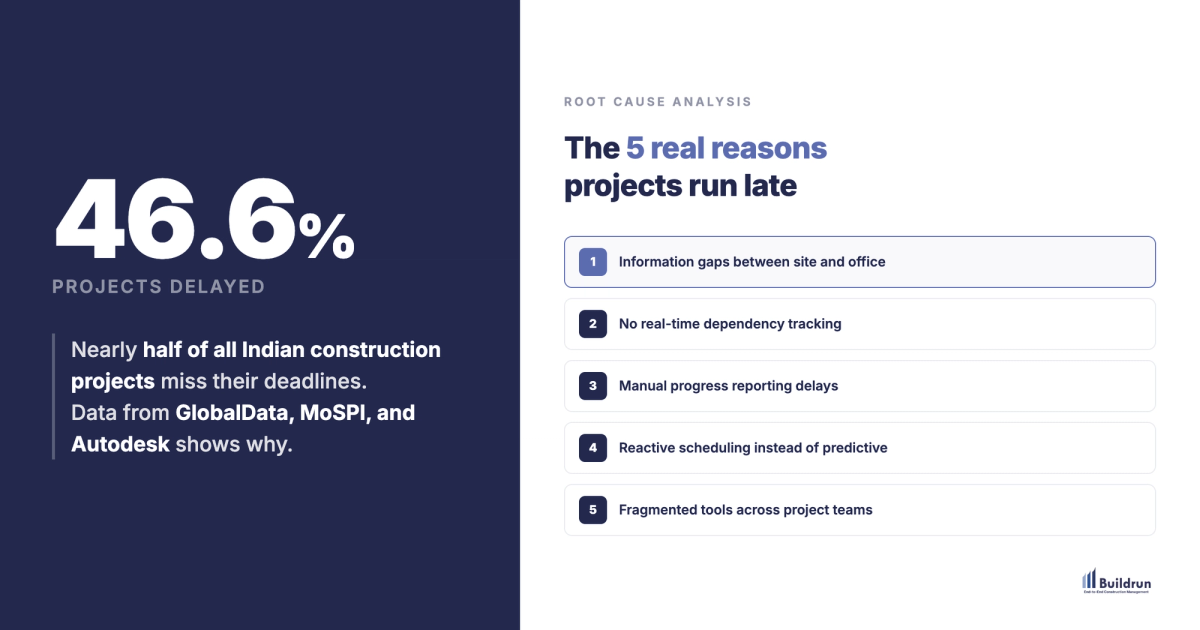
And yet, according to GlobalData, 46.6% of Indian construction projects experience delays.
That number has barely moved in a decade - despite billions invested in project management tools, ERPs, and scheduling software. The tools got better. The delays stayed.
This article looks at why. Not with opinions, but with data from industry reports, government records, and patterns observed across 25 million+ sq.ft. of active construction projects.
Before discussing causes, it helps to understand the scale.
The Ministry of Statistics and Programme Implementation (MoSPI) reported in December 2025 that 1,392 government infrastructure projects had accumulated cost overruns totalling Rs 5.42 lakh crore. These are government infrastructure projects - highways, railways, power plants - not private real estate. But the pattern is relevant because the root causes overlap: approval bottlenecks, coordination failures, and information that reaches decision-makers too late.
In private real estate, the pressure is different but equally intense. RERA has introduced hard deadlines with financial penalties. A delay that would have been quietly absorbed five years ago now carries regulatory reporting obligations and real monetary consequences.
The Autodesk-Deloitte State of Digital Adoption report (2024) adds another layer. Indian construction firms use an average of 8.7 digital tools per project - among the highest adoption rates in the Asia-Pacific region. The problem is clearly not a lack of technology. It is something else.
The Five Root Causes the Data Points To
1. Information Lag Between Site and Leadership
This is the single most consistent pattern across delayed projects. The data exists to prevent the delay - but it does not reach the right person at the right time.
Most project teams discover delays 2-3 weeks after they actually happen (Autodesk-Deloitte 2024). A slab pour slips by two days on a Tuesday. The site supervisor knows. But the planning engineer finds out on Thursday. The project manager updates the schedule on Monday. Leadership sees the revised finish date the following week. By then, the two-day slip has cascaded into a 10-day problem because downstream trades mobilised based on the old schedule.
The gap is not about negligence. It is structural. When progress data flows through verbal updates, WhatsApp messages, and weekly DPR compilations, latency is built into the system.
Teams that have closed this gap - where a site update at 2 PM changes the projected finish date by 2:01 PM - report significantly fewer cascading delays. The fix is not faster people. It is a faster feedback loop between the site and the schedule.
2. Schedules That Don't Recalculate Automatically
On a typical 25-floor residential tower, there are 200+ activities with 40-50 dependency chains. When one activity slips, it can affect 15-30 downstream tasks. Manually recalculating the impact of a single change takes a planning engineer 4-5 hours. On a complex multi-tower project, the full recalculation might not happen until the weekly review meeting.
In the meantime, the schedule shows a finish date that is already wrong.
This is the schedule-to-site gap. Every project has a Gantt chart. The question is: when a task slips at 1 PM, does the schedule reflect the new reality by 1:01 PM - or by Thursday?
Auto-scheduling technology - where the system recalculates all dependent timelines the moment any task status changes - is the most direct solution to this problem. When one slip triggers an instant recalculation across 40 dependency chains, the project manager sees the true finish date within seconds, not days.
3. Quality Documentation That Lives in Silos
A 2,000-unit township generates 30,000-40,000 quality inspection records over its lifecycle. Each record needs photo evidence, location data, inspector identification, and timestamps.
On most projects, this documentation lives across multiple disconnected systems - paper checklists on site, photos in WhatsApp groups sorted by nothing useful, compliance records in a separate register. Finding a specific inspection record from three months ago can take hours. Proving that waterproofing was completed correctly on Floor 12 of Tower B becomes a matter of searching through 15+ chat groups.
When quality records are scattered, disputes take weeks to resolve instead of minutes. More critically, quality problems that could have been caught early go undetected because nobody can aggregate the data fast enough to spot patterns.
Digital quality systems with GPS-tagged photo evidence, searchable by tower, floor, unit, and inspection type, turn quality documentation from an administrative burden into an early warning system. Teams using structured digital QC report completion rates above 95% - compared to roughly 60% with paper-based processes.
4. Resource Conflicts Across Multiple Projects
Tier 1 developers typically manage 5-15 active projects simultaneously. Cranes, RMC plants, specialised subcontractor crews, and key supervisors are often shared across sites. When one project's schedule shifts, it creates resource conflicts that ripple across the portfolio.
The challenge: without a unified view of resource allocation across all projects, these conflicts only surface when two site managers call the same subcontractor and discover they have been double-booked.
Portfolio-level dashboards - where leadership can see resource commitments across every active project in one view - prevent this. When a schedule change on one project triggers an automatic flag showing a resource conflict on another, the operations team can redistribute before the conflict becomes a delay.
5. Vendor and Subcontractor Coordination Gaps
Material delays are consistently cited as a top cause of construction project delays in India. But the root problem is rarely the vendor's performance alone. It is the disconnect between procurement timelines and the construction schedule.
When the procurement team tracks delivery dates in one system and the site team tracks activities in another, the gap between "material needed on site" and "material actually arriving" only becomes visible at the last moment. A two-week delay in procuring a specific grade of TMT steel pushes an entire floor cycle back - and with it, every dependent activity.
Teams that link procurement milestones directly into the construction schedule - where a vendor delay automatically surfaces as a schedule risk weeks before it becomes a site-level problem - consistently handle material disruptions with less downstream damage.
What the Best-Performing Teams Do Differently
The 53.4% of projects that deliver on time are not working with better weather, better subcontractors, or more money. The data suggests they share three characteristics:
- Single source of truth for schedule data. Not eight tools feeding eight dashboards. One system where every stakeholder - from the site engineer to the MD - sees the same status, updated in real time.
- Automated schedule recalculation. When a task slips, the system recalculates all downstream dependencies instantly - before anyone asks "what does this mean for the finish date?"
- Field-first data capture. Progress updates happen at the source - on site, on a phone, in 30 seconds - not through a chain of verbal reports, WhatsApp messages, and weekly compilations.
These are not theoretical best practices. They are operational patterns we have observed across 25 million+ sq.ft. of active projects managed through our platform. The teams that close the gap between what is happening on site and what leadership sees are the teams that protect their delivery timelines.
The Cost of Getting It Right - and Getting It Wrong
For a developer managing Rs 500 Cr+ of active projects, the arithmetic is straightforward. RERA penalty exposure alone can run Rs 8-10 lakh per flat per year of delay. Across 200 units, even a one-month delay carries a cost that far exceeds the investment in better execution systems.
But the bigger cost is subtler. It is the compound effect of decisions made on data that is three to seven days old. It is the meeting that spends 55 minutes figuring out what happened and only 5 minutes on what to do next. It is the planning engineer who spends 8-10 hours every week updating schedules manually instead of analysing trends and flagging risks.
The data is clear: construction project delays in India are not primarily a planning problem. Most developers plan well. The problem is that plan and reality diverge - and the divergence goes undetected until it is too late to correct cheaply.
The projects that deliver on time have built systems where that divergence is detected in minutes, not weeks.
If your team manages multiple active sites and wants to see how real-time schedule intelligence works on your actual project data, we would be glad to show you. No pitch decks - just your data, our platform, and an honest conversation about what fits.
This content is for informational purposes only. RERA regulations vary by state and are subject to change. Consult your legal team for compliance requirements specific to your project and jurisdiction.
See how this works in practice
Buildrun gives construction teams live project data, automated scheduling, and real-time progress tracking - across every site, every day. See it working on a real project.